
Water Cycle Coloring Pages (14 Free Printable Science Sheets)
Did you know the water in your glass today could once have fallen as rain on a mountain or flowed down a river? That is the magic of the water cycle, and these water cycle coloring pages help kids see how it works. These 14 free printable science sheets make the topic hands-on and fun.
The water cycle is the never-ending journey water takes around our planet — a perfect introduction to the water cycle for kids. It has four main steps: evaporation, condensation, precipitation, and collection. The sun heats water in the ocean, lakes, and rivers, water vapor rises and forms clouds, rain and snow fall back down, and the water gathers again so the cycle can start over.
Teachers and parents will love how these sheets double as a printable water cycle worksheet. Younger children can start with the simple cloud and raindrop pages, while older kids can tackle the labeled diagrams and the blank-label challenge. Every water cycle coloring sheet here is free to print.
What’s in This Water Cycle Collection
This set of water cycle coloring pages includes 14 printable science sheets:
- Full Water Cycle Diagram (labeled)
- Water Cycle Diagram (blank labels for kids to fill in)
- Evaporation: Sun Warming the Ocean
- Condensation: Clouds Forming
- Precipitation: Rain Falling
- Precipitation: Snow Falling on Mountains
- Collection: River Flowing to the Sea
- Happy Raindrop Character on a Journey
- Water Cycle in a Circle With Arrows
- Plants Releasing Water (transpiration)
- Rainbow After the Rain
- Water Cycle Landscape Scene (detailed, for older kids)
- Puddle and Umbrella Rainy Day
- Simple Cloud and Raindrops (easiest, for little kids)
How to Print These Water Cycle Coloring Pages
Open the page you want and print it on standard US Letter or A4 paper, choosing the “fit to page” setting so the whole diagram fits neatly with a clean border. Regular printer paper works well for crayons and colored pencils; thicker paper or card stock is better for markers or watercolor paints. For class, print the labeled and blank-label diagrams back to back, so kids can study, then test themselves.
The 14 Water Cycle Coloring Pages
1. Full Water Cycle Diagram (labeled)
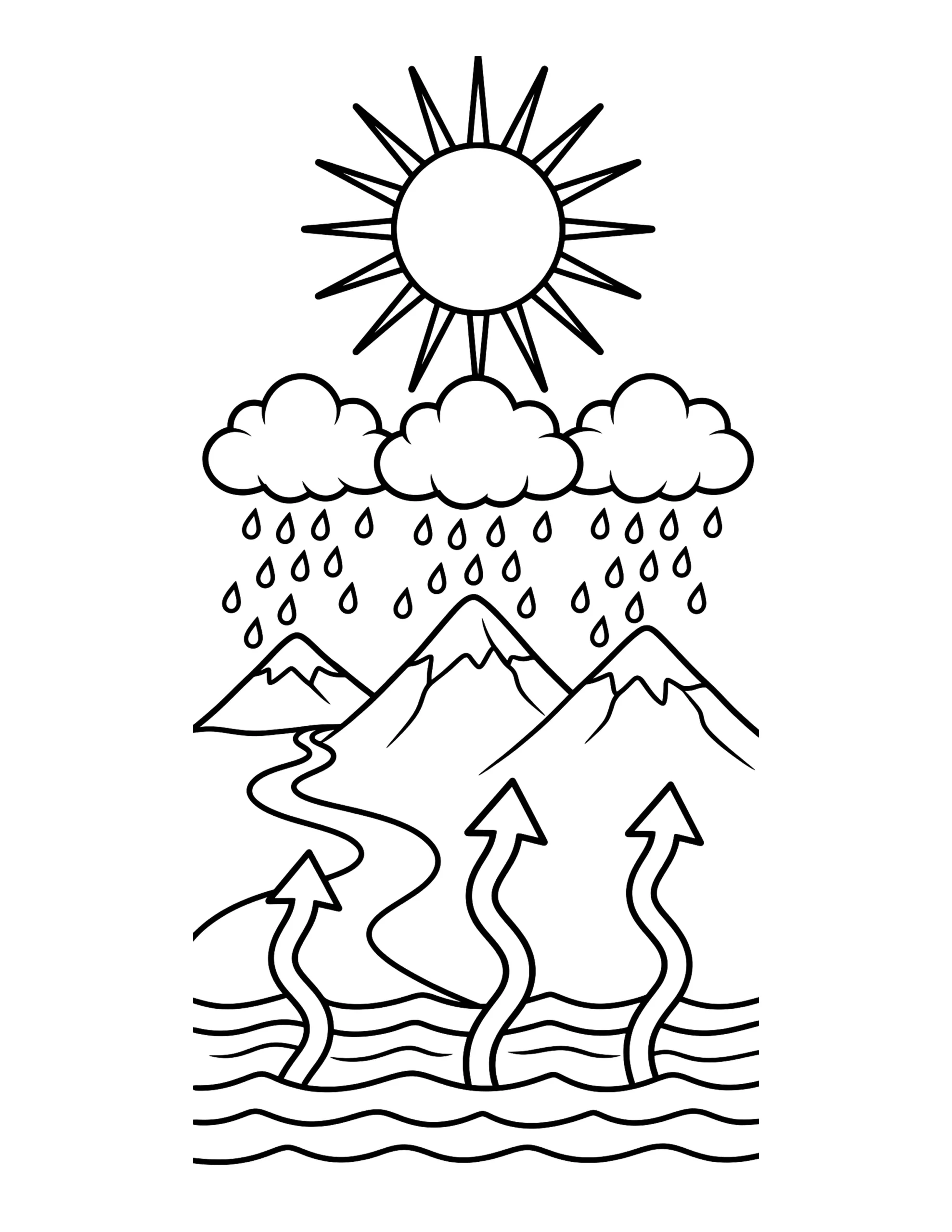
This classic water cycle diagram coloring page shows the sun, the ocean, rising water vapor, clouds over the mountains, falling rain, and a river flowing back to the sea — all labeled clearly. It is the best starting page because kids see all four steps in one picture. Coloring tip: use a different color for each step and say its name aloud as you color.
2. Water Cycle Diagram (blank labels for kids to fill in)

This page shows the same friendly diagram, but the labels are empty boxes. Kids write evaporation, condensation, precipitation, and collection in the right places themselves, turning coloring into a gentle quiz. Learning tip: try it from memory first, then check your answers against page 1.
3. Evaporation: Sun Warming the Ocean
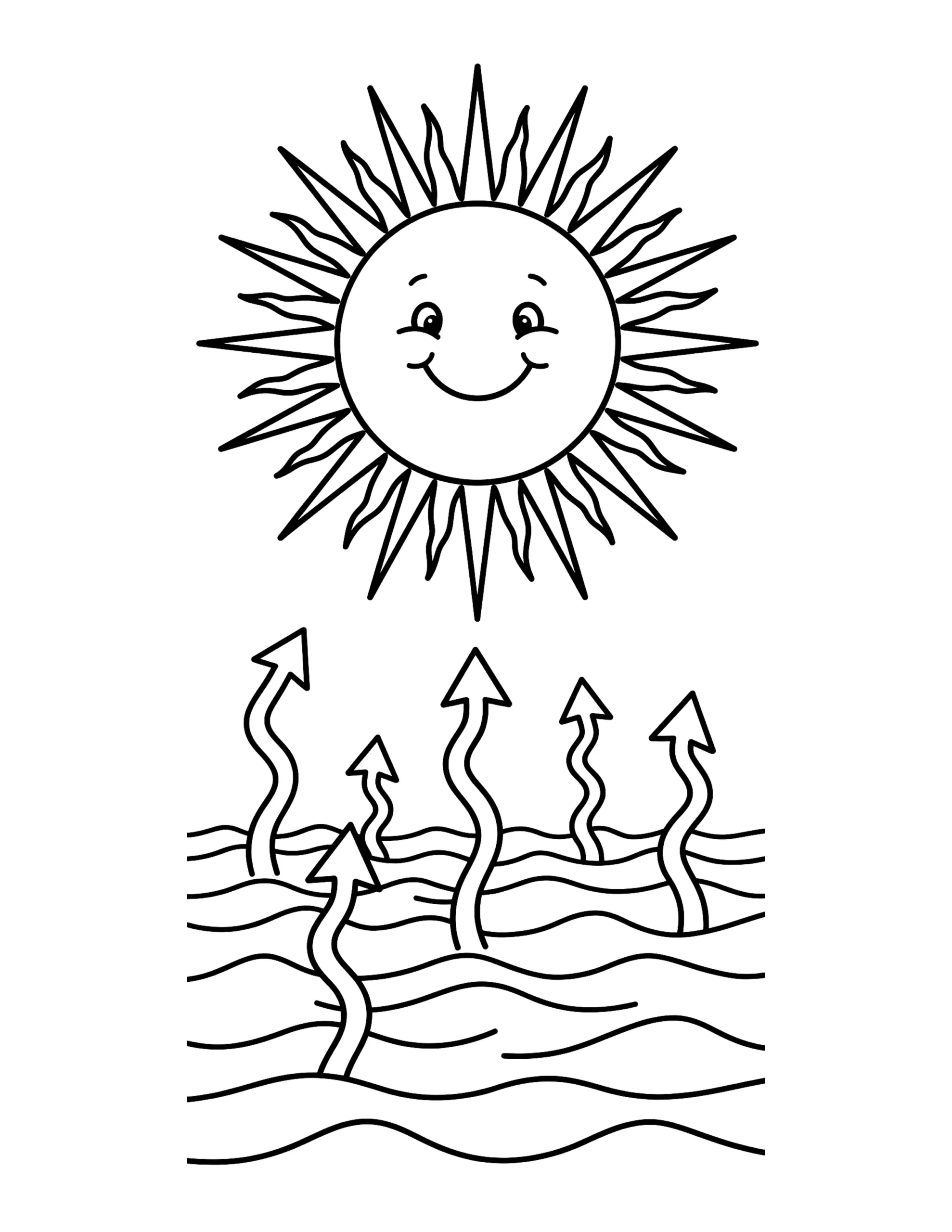
A big, cheerful sun beams down on a wide ocean while wavy arrows of water vapor rise from the surface. This page teaches the first step: the sun heats water and turns it into an invisible gas. Coloring tip: use yellows and oranges for the sun, deep blues for the ocean, and light swirly lines for the rising vapor.
4. Condensation: Clouds Forming
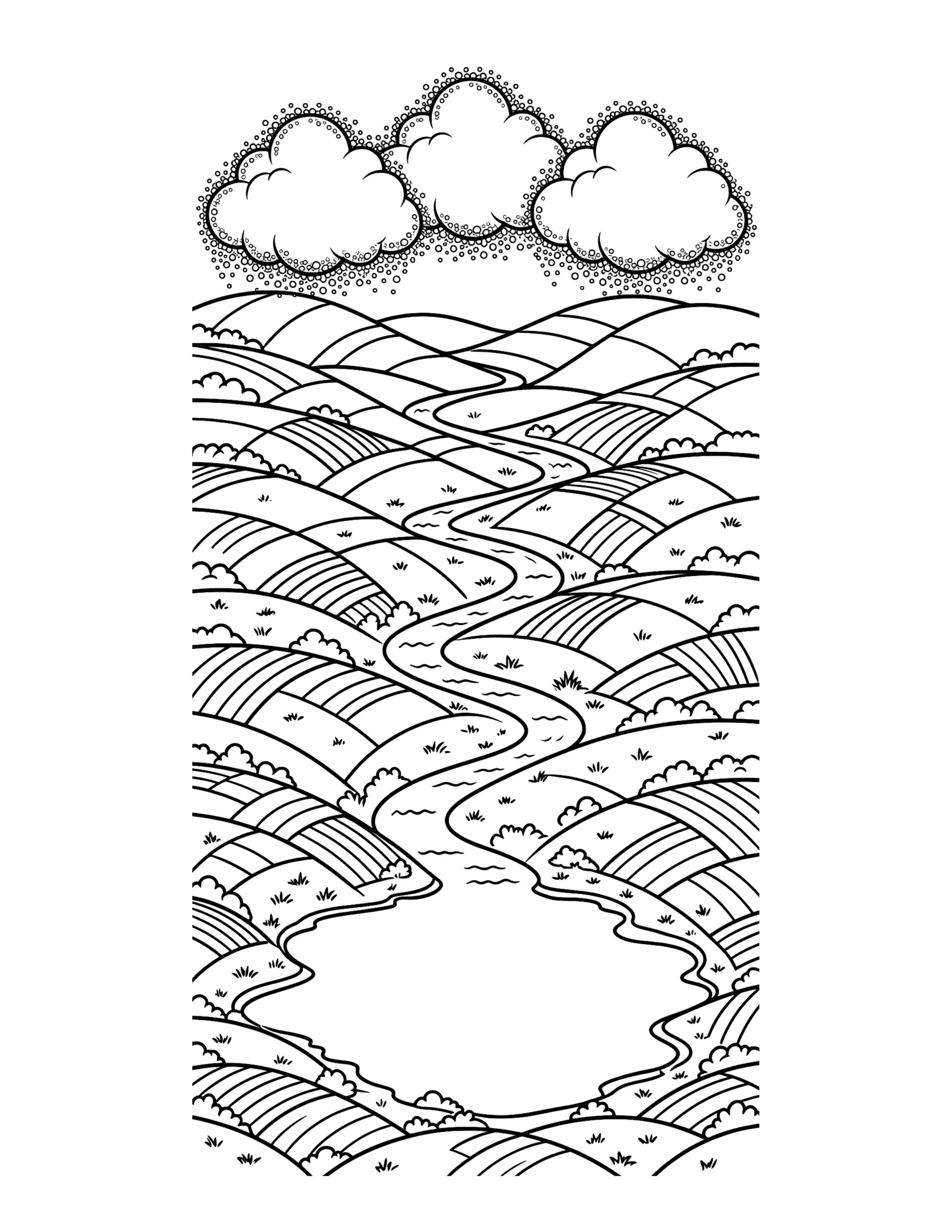
High above the Earth, tiny water droplets gather together to make soft, puffy clouds. This page shows the second step, where water vapor cools down and changes back into liquid droplets. Coloring tip: leave most of the cloud white and shade the edges with light grey or pale blue.
5. Precipitation: Rain Falling
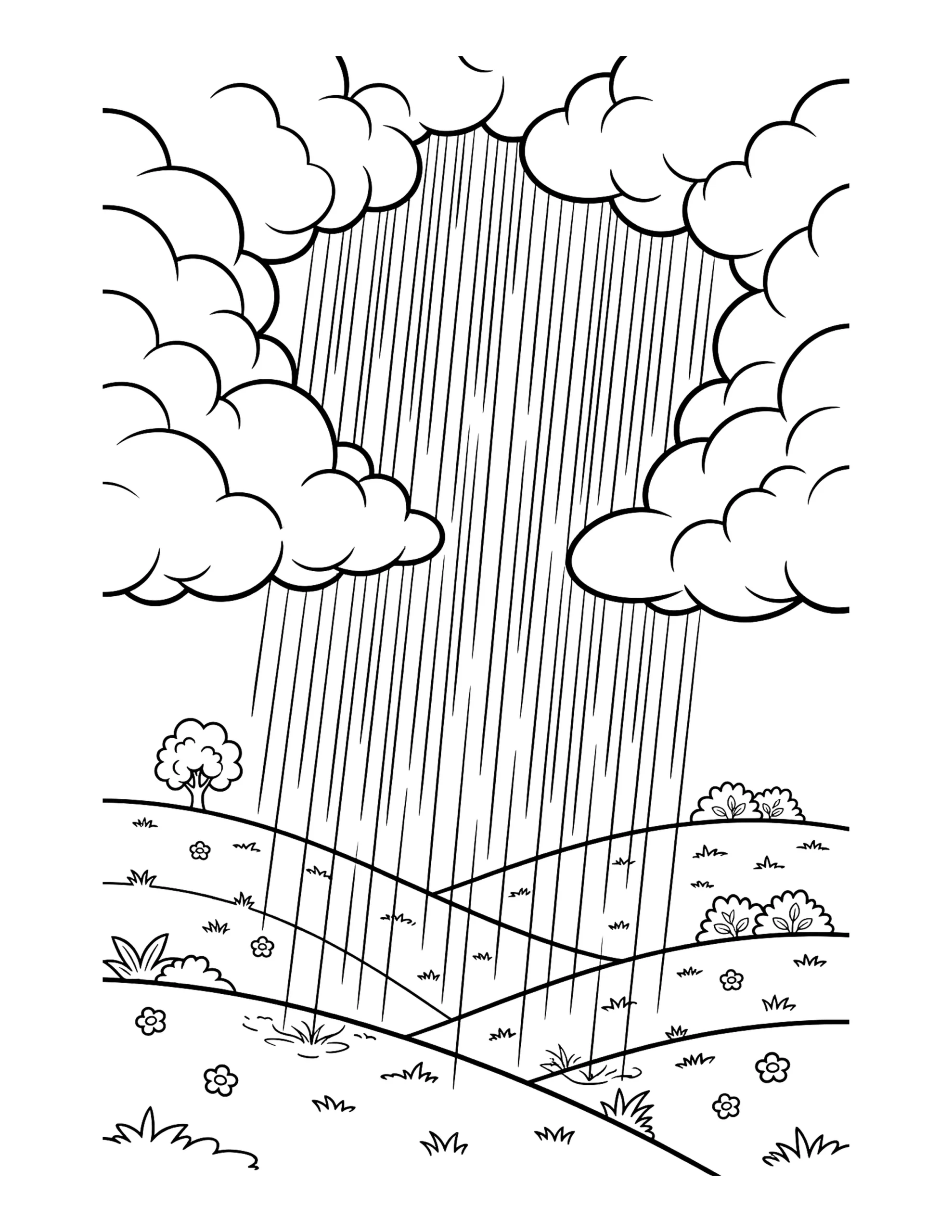
Here the clouds open up and rain pours down over the hills. This is precipitation — the step where water falls back to Earth because the droplets in the clouds have grown too heavy to float. Coloring tip: longer, darker blue streaks make a heavy shower, while short, light ones make gentle drizzle.
6. Precipitation: Snow Falling on Mountains

On this page, soft snowflakes drift down onto tall mountain peaks, showing that in cold places water falls as snow instead. Coloring tip: keep the snow bright white, use cool purples and blues for the mountain shadows, and save your sparkliest pencil for the snowflakes.
7. Collection: River Flowing to the Sea

A winding river carries water down from the hills, past trees and rocks, until it joins the ocean. This is collection, where fallen water gathers in rivers, lakes, oceans, and even underground as groundwater. Coloring tip: follow the river with your pencil as you color, from mountains to sea.
8. Happy Raindrop Character on a Journey
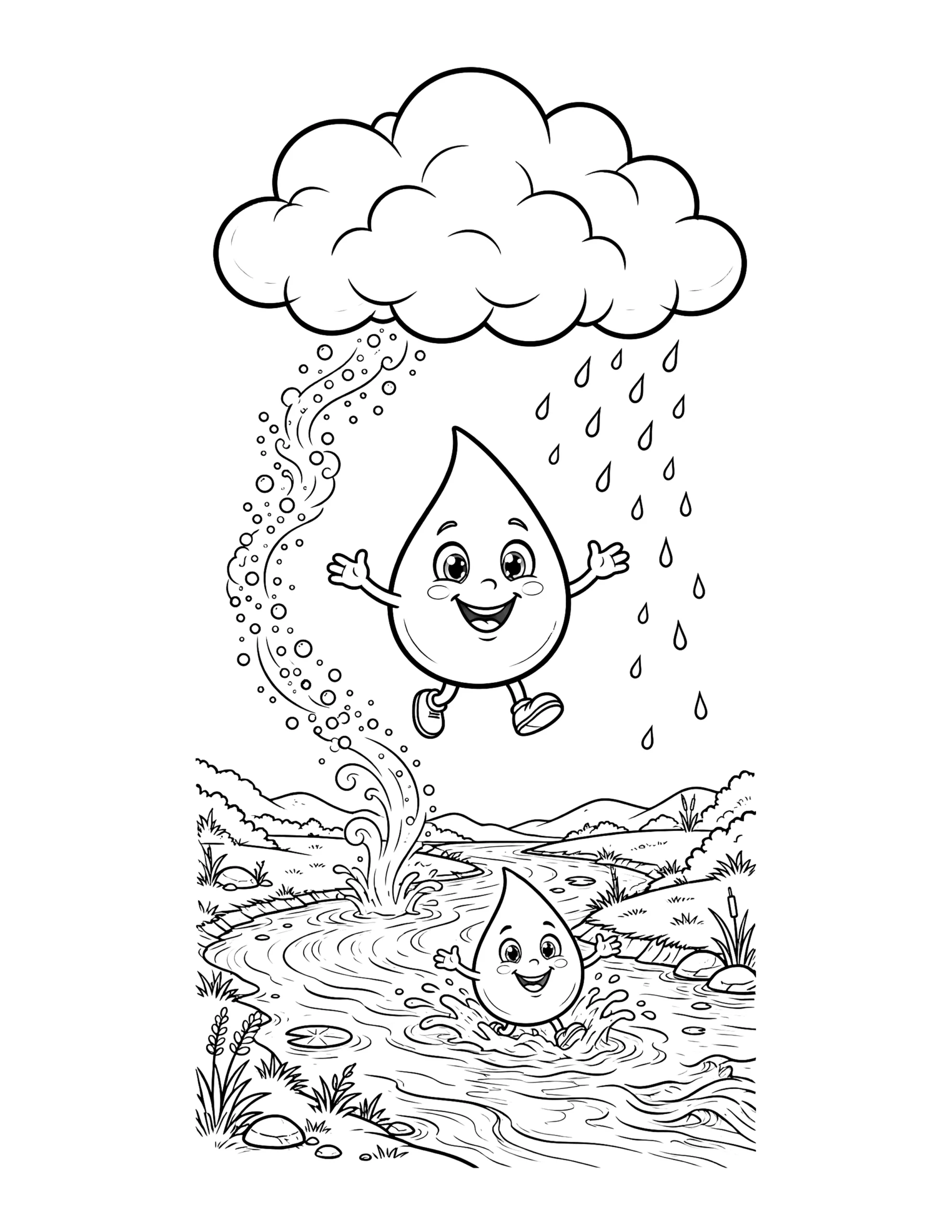
Meet a smiling raindrop traveling through the whole cycle — up into a cloud, down with the rain, and along a river. It makes the science feel like a story for younger learners. Learning tip: after coloring, tell the raindrop’s journey out loud in order, step by step.
9. Water Cycle in a Circle With Arrows
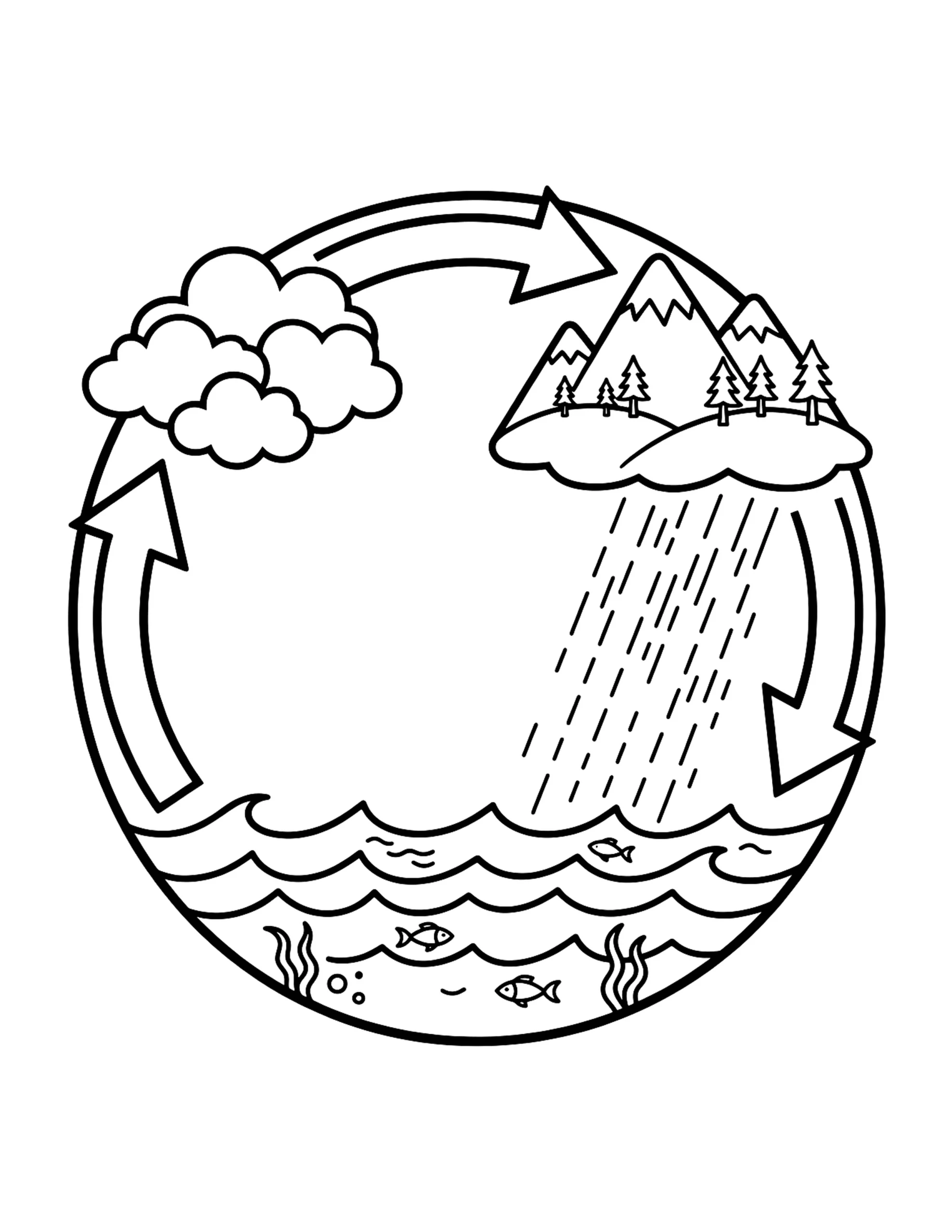
The whole cycle is drawn in one big circle, with chunky arrows leading from the ocean up to the clouds, across to the mountains, and back down again. It teaches a key idea: the water cycle has no beginning and no end. Coloring tip: color the four arrows in four bright, different colors so the direction of the journey stands out.
10. Plants Releasing Water (transpiration)
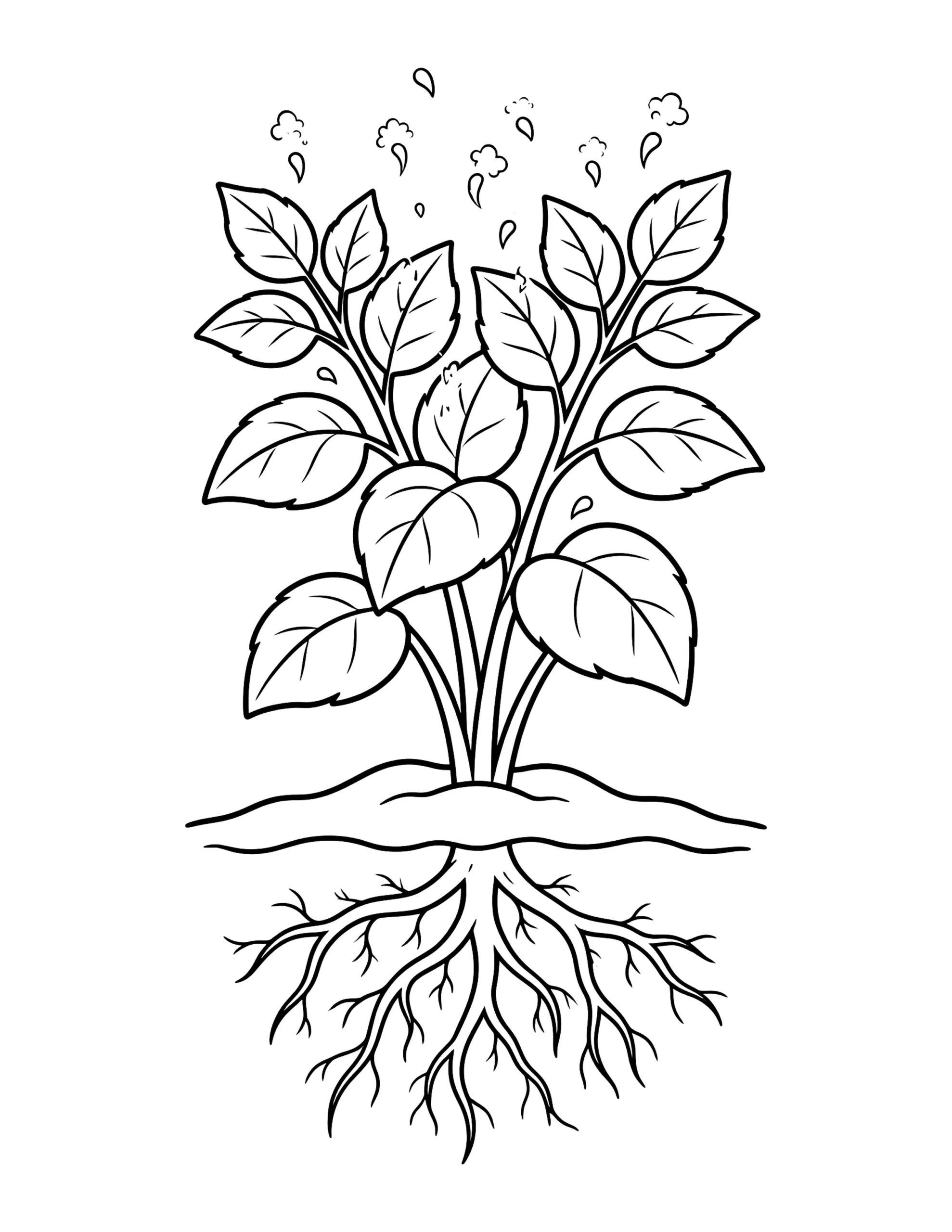
This page zooms in on a leafy plant with tiny droplets of water vapor rising from its leaves — a step called transpiration. Plants soak up water through their roots and release some of it into the air, so plants are part of the cycle too. Coloring tip: use lots of greens for the plant and pale blue swirls above it for the escaping water.
11. Rainbow After the Rain
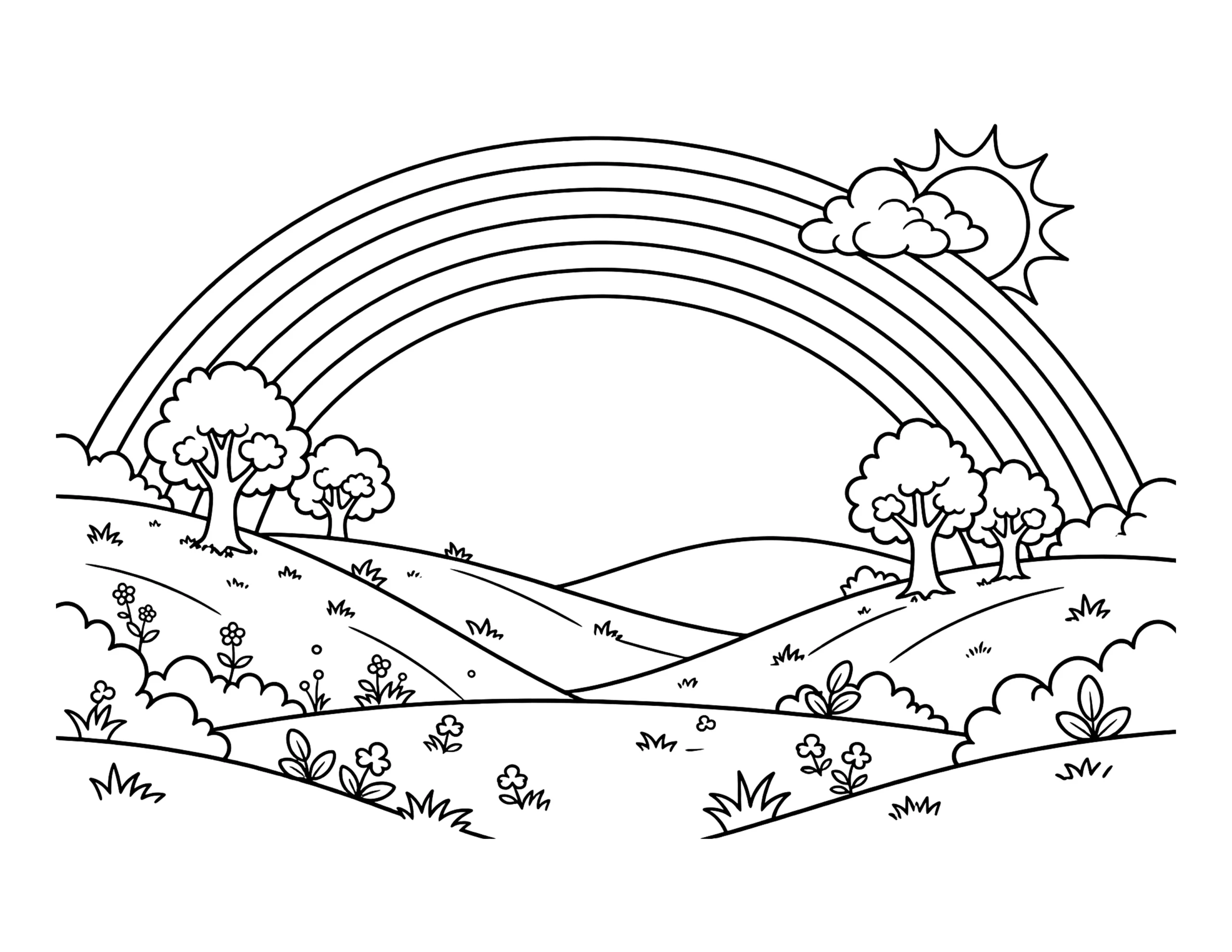
The rain has stopped, the sun is peeking out, and a wide rainbow arcs over a fresh landscape. Rainbows appear when sunlight shines through tiny water droplets still floating in the air, a lovely science talking point. Coloring tip: remember the rainbow order — red, orange, yellow, green, blue, indigo, violet — from the outside band inward.
12. Water Cycle Landscape Scene (detailed, for older kids)
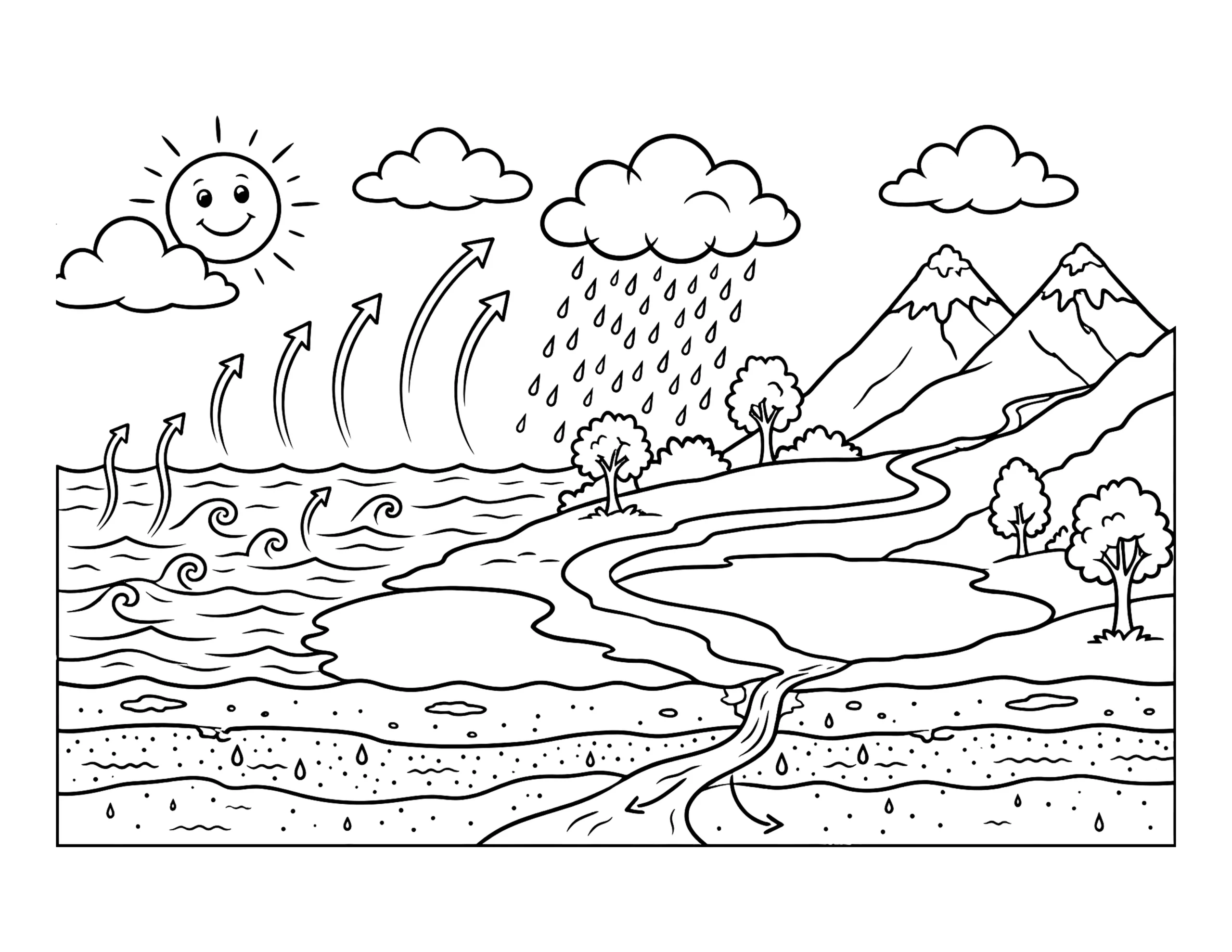
This detailed page shows one landscape with the sun, ocean, rising vapor, clouds, rain, snowy peaks, a river, a lake, underground groundwater, and a runoff stream. Learning tip: challenge yourself to find and name all four steps — plus transpiration and runoff.
13. Puddle and Umbrella Rainy Day
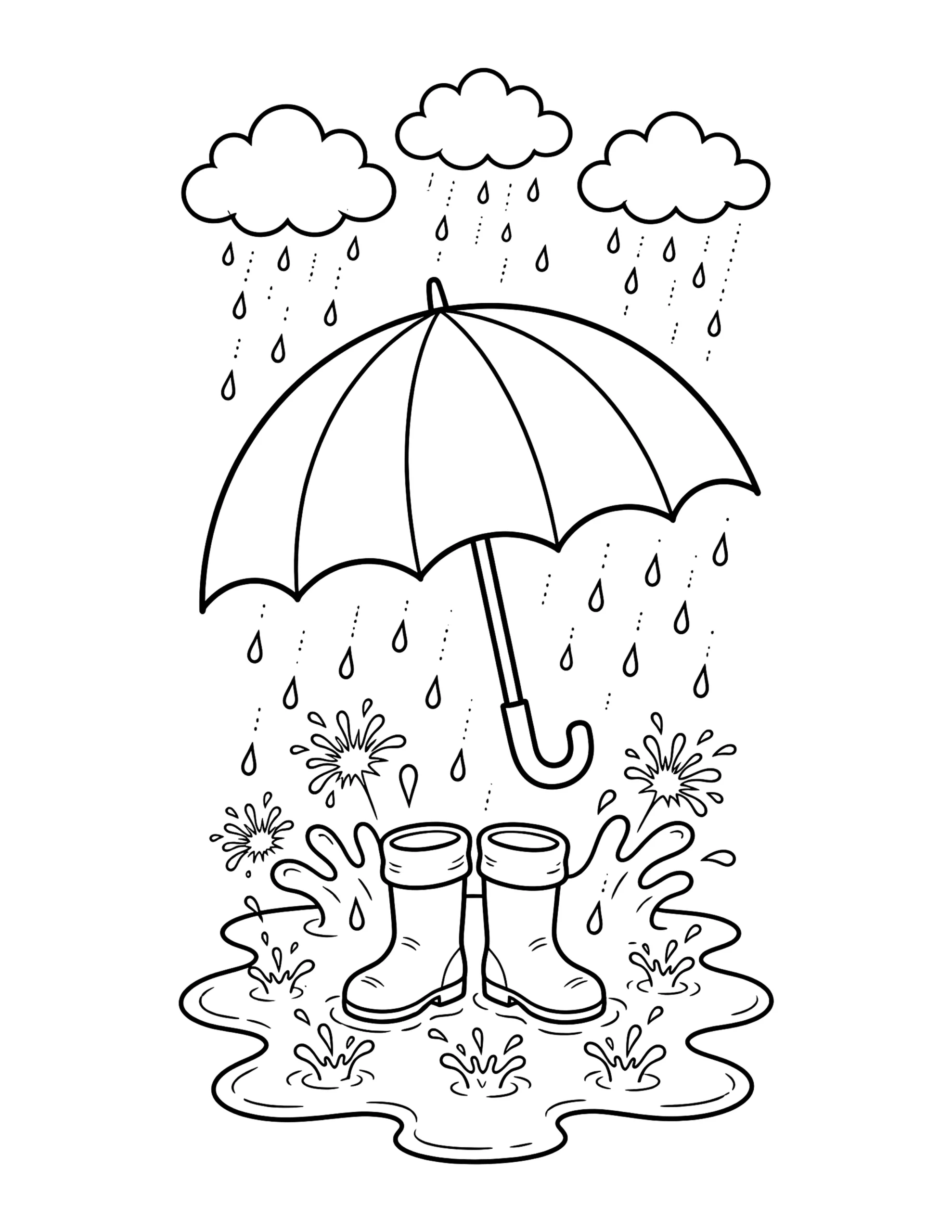
A happy rainy-day scene with a big umbrella, boots, and a splashy puddle shows the cycle in everyday life. Puddles are collection in action — and tomorrow that puddle will slowly evaporate in the sun. Coloring tip: color the puddle a reflective sky blue and add little splash crowns where raindrops land.
14. Simple Cloud and Raindrops (easiest, for little kids)
The easiest page in the set: one big, friendly cloud and a few fat raindrops, with bold outlines and lots of space. It is made for toddlers and preschoolers. Coloring tip: just say “the cloud makes rain” while little ones color.
Fun Facts About the Water Cycle
The 4 Steps of the Water Cycle
Evaporation. The sun heats water in oceans, lakes, and rivers, and some of it turns into an invisible gas called water vapor and rises into the air.
Condensation. High above the Earth the air is cold, so the water vapor cools and changes back into tiny liquid droplets. Together, they form clouds.
Precipitation. When the droplets grow big and heavy, gravity pulls them back down to Earth. Water falls as rain, snow, hail, or sleet,
Collection. The fallen water gathers in oceans, lakes, and rivers, and some soaks into the ground to become groundwater. Then the cycle starts over.
The sun powers the whole water cycle. The sun is the engine that keeps Earth’s water moving — without its heat, the cycle would stop.
Most of Earth’s water is salty ocean water. About 97 out of every 100 drops of water on Earth are in the oceans. Only a tiny share is fresh water.
Clouds are made of tiny water droplets or ice crystals. A cloud looks solid and fluffy, but it is really a floating crowd of tiny droplets. In very cold clouds, the droplets freeze into ice crystals.
Water vapor is invisible. You cannot see water as it rises during evaporation — it is a clear gas mixed into the air. The white steam above a hot drink is droplets that have already condensed.
The water on Earth today is ancient and recycled. The water you drink has been through the cycle again and again for millions of years. Earth reuses the same water forever.
Plants release water too. Through transpiration, plants let water vapor escape from tiny openings in their leaves. A large tree can release hundreds of litres of water into the air.
Water Cycle Activity Ideas
Make a water cycle in a bag. Pour a little warm water into a zip-top bag, seal it, and tape it to a sunny window. Soon droplets form at the top of the bag (condensation), grow heavy, and slide back down (precipitation).
Make a cloud in a jar. With an adult’s help, pour hot water into a jar and hold a plate of ice cubes over the top. The warm vapor rises, cools, and forms a real little cloud inside the jar,
Keep a weather diary for a week. Each day, draw the sky, note whether it rained or snowed, and watch what happens to any puddles. Puddles shrink on sunny days because of evaporation and grow again when precipitation returns.
Label your own water cycle drawing. After coloring the blank-label diagram on page 2, draw the whole cycle from memory on a fresh sheet — sun, ocean, arrows, clouds, rain, and river.
Coloring Tips for Water Cycle Pages
Keep several blues handy: pale blue for gentle rain and vapor, medium blue for rivers and lakes, and deep blue for the ocean. Color the arrows in the diagrams with bright, bold colors like red, orange, or purple so the direction stands out. Keep clouds mostly white with soft grey or light blue shading, and use warm yellows and oranges for the sun. On the labeled diagram, match each label color to its part of the picture: orange for evaporation, grey-blue for condensation, blue for precipitation, green-blue for collection.
Water Cycle Coloring Pages FAQs
What are the 4 steps of the water cycle?
The four steps are evaporation, condensation, precipitation, and collection. The sun heats water in oceans, lakes, and rivers so it rises as water vapor (evaporation); the vapor cools and forms clouds (condensation); water falls as rain or snow (precipitation); and it gathers again in oceans, lakes, rivers, and underground (collection).
Are these water cycle coloring pages free?
Yes — every page in this collection is completely free to print at home or at school. Print as many copies as you need for your family, classroom, or a whole science unit.
What grade is the water cycle taught in?
It is typically introduced in the elementary grades, often around grades 3 to 5 in the US, though younger children often meet the simple idea of rain and puddles earlier. Timing varies by school, so these pages suit a wide age range.
How can I explain the water cycle to a child?
Tell it like a journey: “The sun warms the water and lifts it into the sky, it joins together to make clouds, it falls back down as rain, and it gathers in rivers and the sea — then it starts all over again.” Coloring the circular diagram on page 9 while you talk makes the idea click fast.
Can teachers use these water cycle sheets in class?
Absolutely — teachers are welcome to print these sheets for classroom use. The labeled diagram works as a teaching handout, the blank-label version makes an easy no-prep assessment or homework task,
Keep Coloring and Keep Learning
If your young scientist enjoyed these sheets, there is plenty more exploring to do. Look out for weather coloring pages for sunny, snowy, and stormy days, science coloring pages covering more big ideas from the natural world, and rainbow coloring pages for another chance to practice those seven rainbow colors. Pair a coloring session with the water cycle in a bag experiment, and the science will stick.

15 Comments